


×

Screening and storage plates:
how to choose them?
The different types of plates
Screening plates
The screening plates are multi-well plates where each well is used as a small test tube. They are available in different types of materials: polystyrene, glass background, and colored background. They are ideal for absorbance, fluorescence, luminescence, and scintillation applications. The 96-well plates are the most widely used, but the 384-well and 1536-well plates allow complete automation and miniaturization of dosing.
These plates allow to :
- test samples ;
- determine their composition, the presence, and quantity of a substance (e.g. hormone) ;
- study the action of a drug or the links between biological molecules (e.g. enzyme) ;
- analyze proteins (quantity and concentration).
Storage plates
Made of inert polypropylene and resistant to +121 °C, they are ideal for storage.
We have a wide range of plates to meet your needs.
Contact a technical advisor!See all plates
How to choose your screening and storage plates?
Depending on your needs and applications (absorbance tests, sample recovery, ELISA tests, storage, ...), four main parameters must be taken into account when choosing your plates: type of material, well configuration (type and bottom), plate color, and type of treatment. Find below a guide to help you in your plate selection.
Type of material
Polystyrene
- Low chemical resistance
- From weak to very strong binding capacity, depending on surface treatment
- Rigid and transparent, excellent optical properties
- Applications: homogeneous tests, ELISA, cell culture, fluorescence, luminescence
Cycloolefine
- Low level of autofluorescence
- Excellent transparency especially in the UV range
- Good chemical resistance
- Applications: spectroscopy, fluorescence, and confocal microscopy
Polypropylene
- Good thermal and chemical resistance
- Very low binding capacity
- Flexible, translucent
- Applications: storage, fluorescence, luminescence
Fond en verre
- High optical quality
- Great flatness
- Flexible, translucent
- Applications: spectroscopy, fluorescence, and confocal microscopy
Well configuration
Well type:
- Rounded: optimal for sample retrieval, compatible with most sealing options
- Squared: the angles prevent the capillary rise of liquids and cross-contamination between wells. Maximization of volume in SBS format
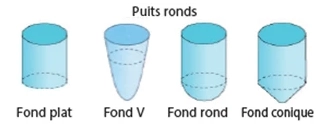
Bottom type :
- Flat: imaging, cell culture
- Rounded: optimal washing, mixing, base visualization, and resuspension, automatic centralization of samples
- V: precipitation, centrifugation, collection of small volumes
- Pyramidal conical: increases volume recovery and decreases dead volume
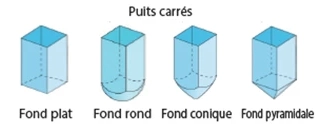
Plate colour
White : recommended for luminescence (e.g. luciferase); increases the signal in relation to the background noise; reflects, concentrates the signal at the detector
Transparent : colorimetric tests, cell culture, ELISA, absorbance tests
Translucent : storage
Black : recommended for fluorescence (e.g. GFP); low autofluorescence and diffusion of fluorescence between wells
Type of treatment
Untreated (or medium fixation) :
Untreated polystyrene is naturally hydrophobic, enabling passive binding and the immobilization of large molecules such as antibodies.
High fixation :
Fixation of medium (> 10 kD) and large molecules that possess ionic groups and/or hydrophobic regions
Non-binding:
Non-binding surfaces minimize the binding of molecules such as DNA, RNA, peptides, and proteins, reducing non-specific interactions and improving the signal-to-background ratio.
Reinforced culture treatment :
This treatment reinforces the adhesion and development of cells
Standard culture treatment :
Improves cell adhesion and protein binding to the surface
Low binding treatment :
The low binding treatment minimizes cell attachment, protein uptake, enzyme activation, and cell activation while remaining non-cytotoxic.
Coating:
This treatment, which combines collagen, poly-D-lysine and fibronectin, enhances the adhesion of difficult-to-cultivate cells.